Welcome!
This website was originally designed to provide information about the ancestors and descendants of my father, Wayne Henry Carter (1923-1979), and my mother, Mary Mirah Jones (1924-2010).
It has since been expanded to include the ancestors and descendants of our Carter progenitor, Richard Cater 1st (1598-1611 - 1677-1679).
These descendants and ancestors include the families of John and Hannah Knight Carter (née Libby) who settled in the Great Salt Lake Valley in the 1850s.
All descendants directly related to anyone in these families or through marriage are encouraged and welcome to join this website. It's free for all family members!
Cater-Decatur Family Organization

Richard Cater 1st was born in Devon, England in the early 17th century and immigrated to the New Hampshire region of the New World. His history shows that he was an early settler of Bloody Point along with his daughter, Elizabeth and his son, Richard 2nd.
The Cater-Decatur Family Organization was created by the children of John CATER 3rd.
Ephraim Cater was the son of John Cater 3rd (1775-1863), Grandson of John Cater 2nd (1737-1801), Great Grandson of John Cater 1st (1712-1777), GG Grandson of Edward Cater (c1675-bef 1732) and and GGG Grandson of Richard Cater 2nd.
The first official Cater-Decatur Family Reunion was held on September 26, 1876 and was voted to be a permanent organization by those attending. Today, it is the longest continuing family organization in existence.
John & Hannah Carter (née Libby) Family Organization

John (1768-1852) and his wife, Hannah Knight Carter (née Libby) (1786-1867) left their homes in Maine and New Hampshire during the early 1800s and began traveling westward that eventually spread over much of the Southwest. Their story of migration is rooted in the great migration of the Latter-Day Saints to their final settlement in the Great Salt Lake Valley, Utah Territory.
During their travels westward they arrived in Kirtland Ohio, then the headquarters of the LDS Church. For the next three years, the Saints dedicated much of their time and talents to construct the Kirtland Temple. In the early to mid-1830s, after developing a thriving community in Kirtland, Ohio, violence against the Church escalated to the point that it was no longer safe for members to remain. When the Prophet Joseph Smith moved to Missouri, members followed, leaving behind their comfortable homes, their cherished possessions, and their beloved temple.
They fled to Far West, Missouri in hopes of a brief respite, but unfortunately it was not meant to be. In February 1839, Church members had begun gathering in Illinois after persecution forced them from their homes in Missouri and Ohio finally settling in Nauvoo. In August 1840, plans were formally announced to build another temple in Nauvoo. Regardless, the Saints were undaunted by the fact that they had been forced to leave the Kirtland Temple behind and abandon two temple-building projects in Missouri. Three months later, on April 6, 1841, the temple cornerstones were laid. In June 1844, work on the temple temporarily stopped when the Saints learned of the death of the Prophet Joseph Smith.
Pressure from enemies of the Church made it clear that the Saints would soon have to leave Nauvoo. Leaders had hoped to complete the temple before departing, but as persecution intensified it was decided to abandon their beloved city and temple the next spring. In early 1846, Hannah, with some of her children, left Nauvoo for Kanesville, Iowa. It was in Nauvoo that this family would be forever divided as John and three children remained in Illinois.
When in Kanesville Richard Harrison Carter (1820-1848) answered the call for the Mormon Battalion. The other family member remained in Kanesville until 1851, having been delayed in departing earlier, by helping the Church leaders prepare the emigrant trains for the long journey ahead, finally arriving in Great Salt Lake City, UT Territory on June 20, 1851.
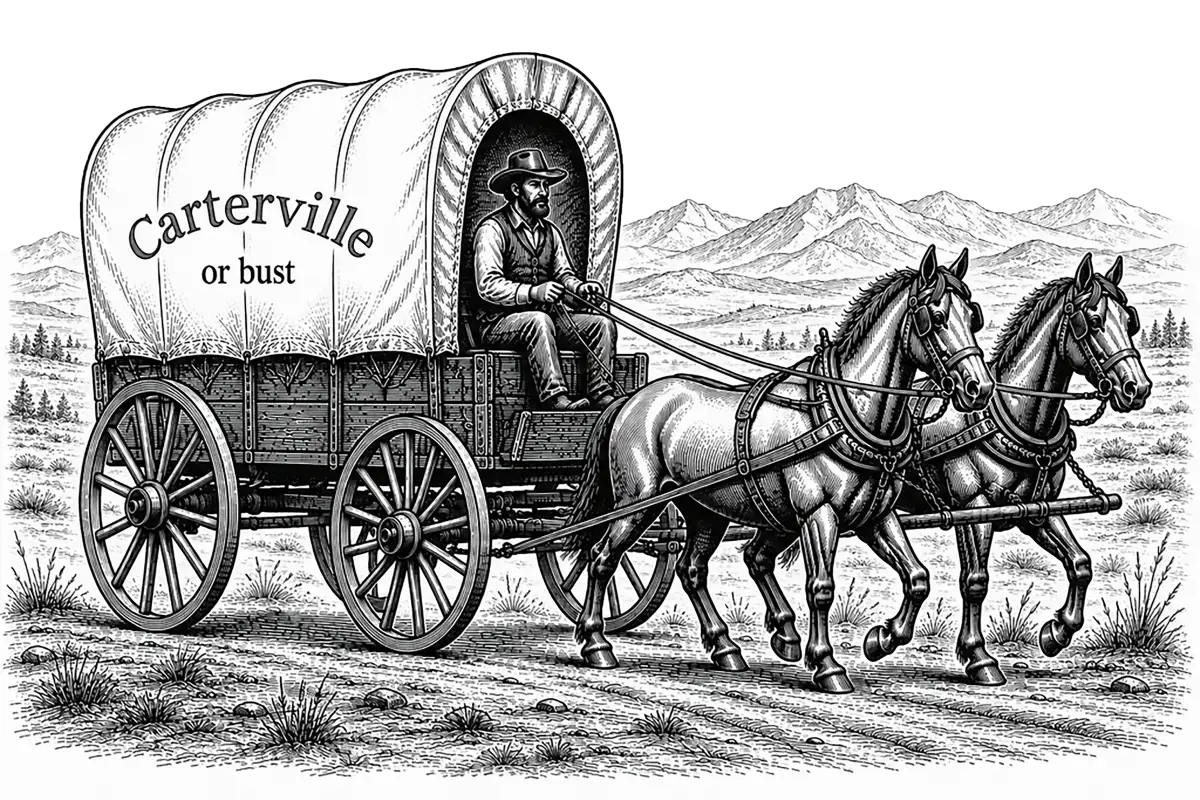
In the early 1870s, John “H” Carter traded his property in Provo which consisted of an adobe house, two log houses, a blacksmith shop, a barn, and several cords of wood, for eighty-five acres of land north and west of Provo, later to be known as Carterville. Through hard work and determination his efforts to make Carterville a thriving community were successful. Over the years, Carterville has been incorporated into the city of Orem and no longer exists today.
The website is named after and in honor of his noble efforts.
Memberships
November 04, 2025

The story of the Mayflower Pilgrims has remained an important part of American history for generations. Interest in preserving the memory of the people who helped shape the early foundations of the United States grew significantly during the nation's centennial celebrations in 1876. Their determination, courage and contribution to the development of American democracy inspired efforts to establish organizations dedicated to remembering their legacy.
The first organized Society of Mayflower Descendants was established in New York City on December 22, 1894. Its purpose was to bring together people who could demonstrate direct, or lineal, descent from one or more of the Mayflower Pilgrims.
The Society seeks to remain a leading organization in preserving the memory and legacy of the 1620 Mayflower Pilgrims through high standards of genealogical research, historical scholarship and the preservation of family history.
For authoritative information about the organization, its history, membership and genealogical research, visit the General Society of Mayflower Descendants official website.

The Sons of Utah Pioneers is committed to remembering and understanding the men and women who helped establish Utah and the American West, and to preserving the legacy they left for future generations.

The Piscataqua Pioneers is an educational, genealogical, historical, and patriotic society whose members trace their ancestry to the early settlers who established communities along both sides of the Piscataqua River and its tributaries before the Declaration of Independence.
The Society is dedicated to identifying, collecting, preserving, and sharing historical and genealogical records relating to the early pioneers of the Piscataqua region of Maine and New Hampshire and to their descendants.
|
Latest Additions/Updates
The following are the latest family Individuals on this site to have been added or reviewed & updated.
Last Update on: October 27, 2026
Florence P SIEBERT
Updated: October 27, 2026
Russell Martin OTTO
Updated: October 27, 2026
Helen Elizabeth MCCREADY
Updated: October 27, 2026
David Pearl ALBERTS
Updated: October 27, 2026
Lindsay John 'Lin' CARTER
Updated: October 27, 2026
Linda Lee MCINTYRE
Updated: October 27, 2026
Monta Ray BREWER
Updated: October 26, 2026
Robert Neil 'Bob' CARTER
Updated: October 26, 2026
Joyce MCCREADY
Updated: October 26, 2026
Infant MCCREADY
Updated: October 26, 2026
Steven Scot DECK
Updated: October 26, 2026
Anthony DECK
Updated: October 26, 2026
Payton Michael Lee BALDWIN
Updated: October 26, 2026
Bryce Allen BALDWIN
Updated: October 26, 2026
Jeffrey Neil BALDWIN
Updated: October 26, 2026
Kathy DECK
Updated: October 26, 2026
William George DECK, Jr.
Updated: October 26, 2026
William George DECK, Sr.
Updated: October 26, 2026
Rose Mary MCCREADY
Updated: October 26, 2026
Mary Jane SMITH
Updated: October 26, 2026
Elmer Raymond 'PeeWee' MCCREADY
Updated: October 26, 2026
Woodrow Wilson MCCREADY
Updated: October 26, 2026
Edward J BENEDICT
Updated: October 26, 2026
Michael Allen BENEDICT
Updated: October 26, 2026
Frank Daniel BENEDICT
Updated: October 26, 2026
Michael SCHLATTER
Updated: October 26, 2026
Kim Marie BENEDICT
Updated: October 26, 2026
Edward Charles BENEDICT
Updated: October 26, 2026
Shirley Ann ALBERTS
Updated: October 26, 2026
Bernice
Updated: October 26, 2026
Thomas ALBERTS
Updated: October 26, 2026
Winnie
Updated: October 26, 2026
Marvin ALBERTS, Jr.
Updated: October 26, 2026
Mary Ellen TRUGAGOS
Updated: October 26, 2026
Marvin LeRoy 'Sonny' ALBERTS
Updated: October 26, 2026
Frank John ALBERTS
Updated: October 26, 2026
Pansy L MCCREADY
Updated: October 26, 2026
Debbie
Updated: October 26, 2026
James Earl LEMMON
Updated: October 26, 2026
Glen H WALLACE
Updated: October 26, 2026
|